

Digital marketing has become an important part of how businesses attract customers, build visibility, and generate sales. But managing everything internally can be harder than it first appears.
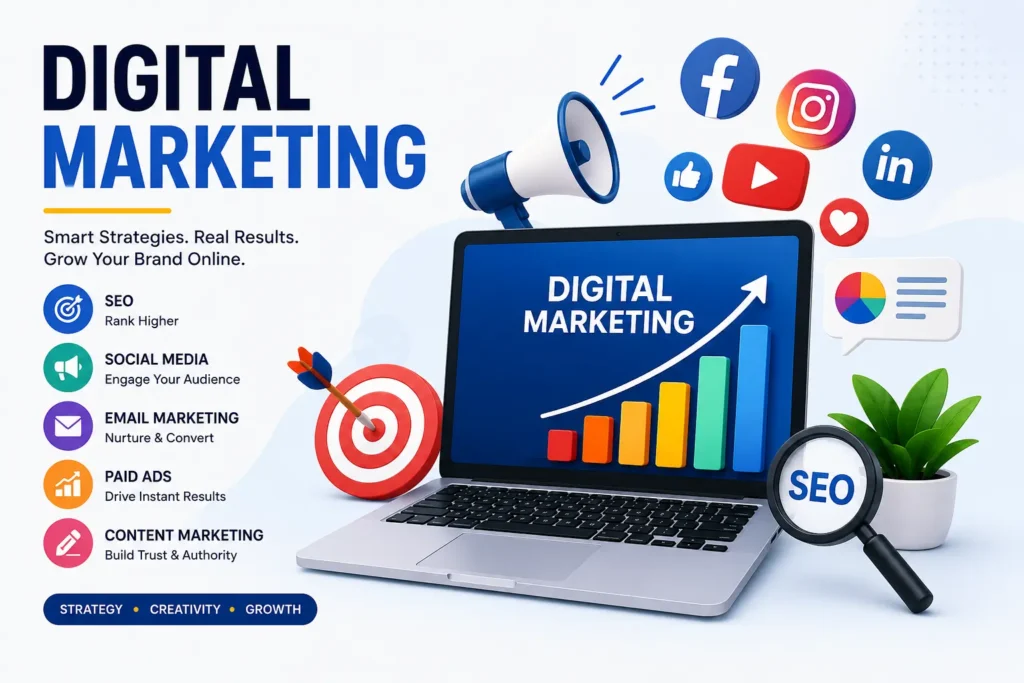
A business may need someone for SEO, another person for paid advertising, a social media specialist, a content writer, an email marketer, and someone to analyse performance. Hiring and managing all these roles can quickly become expensive and time-consuming.
This is why many businesses choose to work with a digital marketing agency instead.
An agency can bring together different skills under one team, giving businesses access to expertise without having to build a large marketing department from scratch.
But does outsourcing really make more sense than hiring an in-house team?
For many businesses, it can.
What Does an In-House Digital Marketing Team Look Like?
An in-house team consists of employees who work directly for the business.
Depending on the company’s size, the team might include:
- SEO specialists
- Social media managers
- Content writers
- PPC specialists
- Graphic designers
- Email marketers
- Marketing managers
- Data and analytics specialists
Having an internal team gives a company direct control over its marketing activities. Employees can become deeply familiar with the brand, products, customers, and internal processes.
The challenge is that building a complete team requires considerable investment in recruitment, salaries, software, training, equipment, and management.
For smaller and growing businesses, maintaining all these resources may not always be practical.
What Is a Digital Marketing Agency?
A digital marketing agency provides marketing services to businesses on an outsourced basis.
Instead of hiring several specialists individually, a business can work with one agency that already has people with different areas of expertise.
Depending on the agency, digital marketing services may include:
- Search engine optimization
- Pay-per-click advertising
- Social media marketing
- Content marketing
- Email marketing
- Conversion rate optimization
- Website strategy
- Analytics and reporting
This model allows businesses to access a wider range of skills without necessarily creating a large internal department.
1. Access to a Wider Range of Expertise
One of the biggest advantages of hiring an agency is access to multiple specialists.
Digital marketing is not one single discipline. SEO requires a different skill set from paid advertising, while social media strategy is different from conversion optimization.
An agency can bring these areas together.
For example, an SEO specialist may identify an opportunity to increase organic traffic while a content specialist develops the supporting content. A paid advertising specialist can then test another acquisition channel while an analytics specialist measures the results.
This level of collaboration can be difficult to achieve with a very small in-house team.
2. Lower Recruitment and Training Pressure
Building an internal marketing department takes time.
A company has to advertise positions, review applications, conduct interviews, hire employees, onboard them, and provide ongoing training.
Digital marketing also changes continuously. Search algorithms evolve, advertising platforms introduce new features, social networks change their formats, and customer behaviour shifts.
An agency has to keep its team up to date across these areas as part of its normal operation.
For a business, this can reduce some of the pressure associated with continuously recruiting new specialists.
3. More Flexible Marketing Resources
An in-house team has a fixed number of people.
If a business suddenly needs additional support for a product launch, seasonal campaign, website project, or new advertising channel, the existing team may already be working at full capacity.
A digital marketing agency can often provide additional resources when required.
For example, a company might use an agency for SEO throughout the year and increase paid advertising support during a major product launch.
This flexibility can be particularly useful for businesses that experience seasonal changes in demand.
4. Access to Professional Marketing Tools
Modern digital marketing often involves a large collection of tools.
Marketers may use platforms for:
- Keyword research
- Competitor analysis
- SEO auditing
- Advertising management
- Social media scheduling
- Analytics
- Reporting
- Content research
- Conversion tracking
Some professional tools can be expensive, particularly when several platforms are required.
An established agency may already have access to many of these resources as part of its marketing operation.
This does not mean tools automatically produce better results. Strategy, execution, testing, and interpretation still matter. However, access to appropriate tools can make research and campaign management more efficient.
5. Faster Execution
Time is another important factor.
A new in-house employee may need weeks or months to understand the company’s marketing systems and develop a working process.
An experienced agency already has established workflows, specialists, reporting systems, and campaign processes.
That can help businesses move from planning to implementation more quickly.
This can be particularly useful when a company needs to improve its SEO, launch a paid campaign, or strengthen its online presence without waiting to build a complete team first.
6. A Fresh Perspective on Your Marketing
Internal teams can become very familiar with a company’s products and processes.
That knowledge is valuable, but it can sometimes make it difficult to look at the business from a customer’s perspective.
An external team can bring a fresh viewpoint.
An agency may notice problems that internal employees have overlooked, such as unclear website messaging, weak landing pages, poor keyword targeting, inconsistent branding, or missed opportunities in the customer journey.
A fresh perspective does not replace internal knowledge. The best results usually come when the agency combines its outside experience with the company’s understanding of its customers and industry.
7. Easier Scaling
Marketing requirements can change as a company grows.
A small business may initially need only basic SEO and social media support. Later, it may need content marketing, paid advertising, email campaigns, technical SEO, and conversion optimization.
Expanding an in-house team every time requirements change can become complicated.
An agency can often adjust the scope of its digital marketing services as the business develops.
This makes it possible to start with a focused strategy and expand when there is a clear business reason to do so.
8. Better Focus on Core Business Activities
Business owners already have many responsibilities.
They may need to manage employees, customers, finances, operations, suppliers, and product development.
Trying to manage every part of digital marketing at the same time can spread internal resources too thin.
Outsourcing selected marketing activities can allow the internal team to focus on what it does best while specialists handle specific marketing tasks.
The goal is not to completely separate marketing from the business. Instead, the agency and internal team should work together around shared objectives.
9. Performance Tracking and Reporting
Marketing decisions should not be based entirely on assumptions.
Businesses need to understand which activities are producing meaningful results.
An agency can establish reporting around metrics such as:
- Website traffic
- Search visibility
- Leads
- Conversion rates
- Advertising performance
- Cost per acquisition
- Engagement
- Revenue-related outcomes
For website measurement, businesses can also use Google Analytics to understand how visitors interact with their websites.
The most useful reports are not necessarily the ones with the largest number of metrics. They are the ones that connect marketing activity with business objectives.
When Does an In-House Team Make More Sense?
Hiring internally is not always the wrong choice.
An in-house team can be a strong option when:
- Marketing is a major part of the company’s daily operations
- The business has enough budget for several specialists
- Employees need to work closely with internal departments
- The company requires dedicated, full-time marketing resources
- There is a clear long-term need for a large marketing department
Larger companies may also choose a hybrid approach, combining internal marketing employees with specialist agencies.
How to Choose the Right Digital Marketing Agency
If you decide to outsource, choosing the right partner matters.
Do not select an agency based only on a low monthly price.
Instead, consider:
Relevant Experience
Look for experience with businesses similar to yours or campaigns involving similar goals.
Clear Strategy
A good agency should be able to explain what it plans to do and why those activities matter.
Transparent Reporting
You should know what work is being performed and how progress will be measured.
Communication
Regular communication helps ensure the agency understands changes in your business and priorities.
Realistic Expectations
Be cautious of agencies promising instant rankings, guaranteed sales, or unrealistic results.
For SEO, it is useful to follow Google Search Central’s SEO Starter Guide, which explains fundamental practices for helping search engines understand website content.
What About a Digital Marketing Company in London?
For businesses operating in London or targeting UK customers, working with a digital marketing company London businesses can communicate with easily may offer practical advantages.
Local knowledge can help an agency understand the competitive environment, customer expectations, geographic targeting, and the needs of businesses serving London audiences.
However, location should not be the only factor.
The agency’s experience, strategy, communication, transparency, and ability to demonstrate meaningful results should carry more weight than simply having a London address.
The Best Approach May Be a Combination
Businesses do not always have to choose between completely outsourcing marketing and building a large internal department.
A hybrid approach can work well.
For example, an internal marketing manager can oversee brand strategy and business priorities while an agency handles SEO, PPC, technical marketing, or social media.
This gives the business internal ownership while still providing access to specialist expertise.
Final Thoughts
Building an in-house marketing team can provide control and deep knowledge of the business, but it also requires significant investment in people, tools, training, and management.
For many small and growing businesses, hiring a digital marketing agency can provide access to a wider range of expertise with greater flexibility.
The right choice depends on your budget, goals, internal resources, and long-term plans.
Instead of asking whether agencies are always better than in-house teams, a more useful question is:
Which approach gives your business the skills, flexibility, and resources it needs to achieve its marketing goals?
For many businesses, combining internal knowledge with professional digital marketing services can provide a practical way to grow online without the cost and complexity of building a large marketing department from the ground up.
Read More:
The Ultimate Digital Marketing Guide for Business Growth in 2026
How Content Marketing Supports Digital Marketing Success
Related Posts
How a B2B Digital Marketing Agency Helps Businesses Generate High-Quality Leads
Generating leads is important for every business, but B2B companies often face a more complicated…
The Ultimate Digital Marketing Guide for Business Growth in 2026
In 2026, businesses can no longer rely only on traditional advertising to attract and retain…
How Data Analytics Improves Digital Marketing Decisions
In today’s competitive online marketplace, successful marketing is no longer based on guesswork. Every click,…
Email Marketing vs Social Media Marketing: Which Is Better for ROI?
In today’s competitive online landscape, businesses are constantly looking for marketing channels that generate the…