



Are your website conversions not meeting your expectations? It could be due to common website mistakes that are driving potential customers away. In today’s digital landscape, your website serves as your virtual storefront. It’s often the first point of contact between your business and potential customers. Therefore, it’s essential to identify and rectify any issues that might be hindering your online success.
In this blog post, we will explore some of the most common website mistakes and provide practical advice on how to improve your website conversion optimization. By understanding these UX mistakes and implementing effective solutions, you can significantly enhance your online presence and achieve better results.
1. Poor Website Design and User Experience (UX)
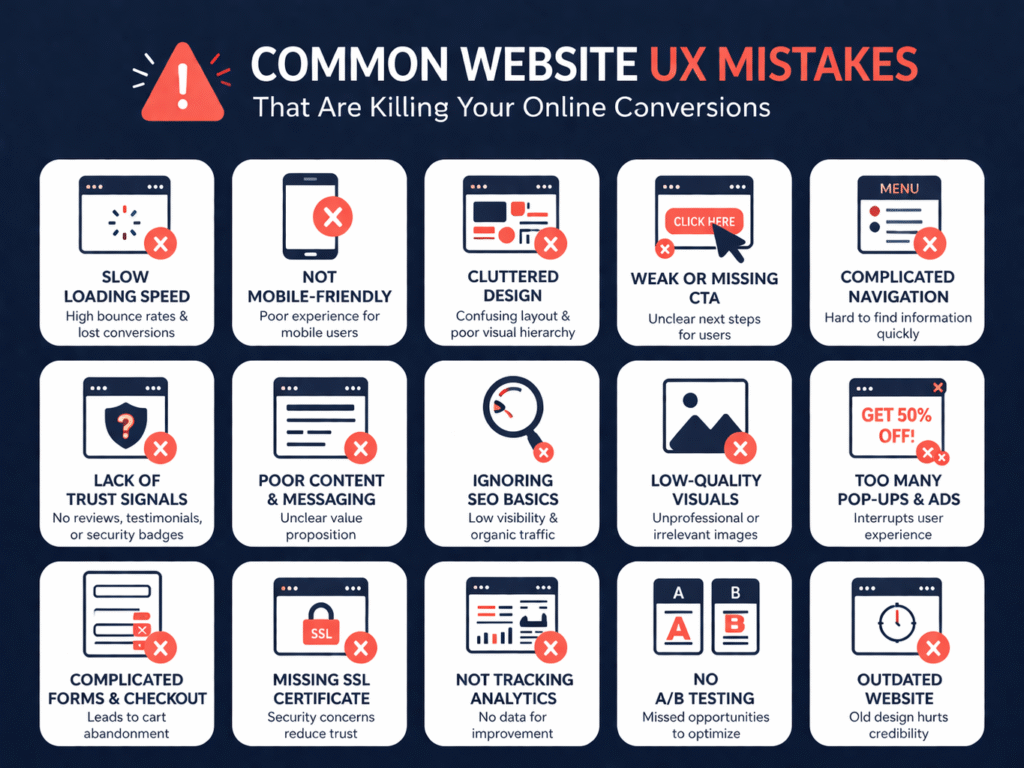
A confusing or cluttered website design can quickly frustrate visitors and lead to high bounce rates. Users expect a seamless and intuitive browsing experience. If your website is difficult to navigate or has a confusing layout, they will likely abandon it in search of a better alternative.
Key UX mistakes to avoid:
- Complex Navigation: Keep your navigation menu clear, concise, and easy to understand. Users should be able to find what they’re looking for within a few clicks.
- Cluttered Layout: Avoid overwhelming visitors with too much text, images, or calls-to-action on a single page. A clean and minimalist design is often more effective.
- Slow Loading Speed: A slow website can significantly impact user experience and conversions. Ensure your website loads quickly on all devices.
- Lack of Mobile Responsiveness: In today’s mobile-first world, it’s crucial to have a website that looks and functions well on smartphones and tablets.
If your website has a high bounce rate or low conversion rate, it might be time to consider a website redesign. A fresh look and improved UX can breathe new life into your online presence and boost your website conversion optimization.

2. Ineffective Call-to-Actions (CTAs)
Your call-to-actions are crucial for guiding visitors towards desired actions, such as making a purchase, signing up for a newsletter, or contacting your business. If your CTAs are unclear, buried, or uninspiring, they won’t be effective in driving conversions.
Tips for creating effective CTAs:
- Be Clear and Concise: Use action-oriented verbs that tell users exactly what you want them to do (e.g., “Sign Up Now,” “Add to Cart,” “Contact Us”).
- Make Them Stand Out: Use contrasting colors, bold fonts, and compelling copy to make your CTAs visually distinct and easy to find.
- Place Them Strategically: Position your CTAs in prominent locations where they are most likely to be noticed, such as above the fold or at the end of a product description.
- Use Compelling Copy: Craft persuasive language that highlights the benefits of taking action. Focus on the value proposition for the user.
- A/B Test Different Variations: Experiment with different button colors, text, and placements to see what works best for your audience.
By improving your CTAs, you can significantly enhance your website conversion optimization efforts.
3. Lack of Trust and Credibility
Building trust and credibility with your audience is essential for driving conversions. If visitors don’t trust your website, they’re unlikely to purchase from you or provide their personal information.
Ways to build trust and credibility:
- Showcase Customer Testimonials and Reviews: Social proof is a powerful tool for building trust. Feature positive reviews and testimonials from satisfied customers prominently on your website.
- Display Trust Badges and Security Seals: If you collect sensitive information, such as credit card details, display trust badges and security seals from reputable organizations like Norton or McAfee.
- Provide Clear Contact Information: Make it easy for visitors to contact your business by providing a visible physical address, phone number, and email address.
- Have a Professional About Us Page: A well-crafted About Us page can help humanize your brand and build a connection with your audience. Share your story, mission, and values.
- Maintain an Up-to-Date Blog: A blog with high-quality, informative content can demonstrate your expertise and thought leadership in your industry.
By addressing these trust-building factors, you can create a more trustworthy and credible website that encourages visitors to convert.
4. Poor Content and Lack of Clear Value Proposition
Your website content plays a critical role in educating visitors about your products or services and persuading them to convert. If your content is poorly written, outdated, or lacks a clear value proposition, it won’t be effective in driving actions.
Tips for creating compelling content:
- Define Your Target Audience: Understand your target audience’s needs, pain points, and motivations to create content that resonates with them.
- Craft a Clear Value Proposition: Clearly communicate the unique value you offer to your customers. What sets you apart from your competitors? Why should they choose you?
- Write Engaging and Informative Content: Create content that is valuable, engaging, and easy to read. Use headings, bullet points, and images to break up large blocks of text.
- Use Compelling Visuals: Incorporate high-quality images, videos, and infographics to enhance your content and make it more visually appealing.
- Keep Your Content Updated: Regularly update your website content to ensure accuracy and relevance. Fresh content also signals to search engines that your website is active and valuable.
By investing in high-quality content that effectively communicates your value proposition, you can significantly improve your website conversion optimization.
5. Neglecting Mobile Users
With a significant portion of web traffic now coming from mobile devices, it’s crucial to have a website that is optimized for smartphones and tablets. If your website isn’t mobile-friendly, you’re alienating a massive audience and missing out on valuable conversions.
Key mobile optimization factors:
- Responsive Design: Implement a responsive design that automatically adapts to different screen sizes. This ensures that your website looks and functions well on all devices.
- Fast Loading Speed: Mobile users expect fast loading times. Optimize your website’s performance by compressing images, minimizing code, and leveraging browser caching.
- Easy Navigation: Ensure your navigation menu is easy to access and use on mobile devices. Consider using a hamburger menu for cleaner mobile layouts.
- Touch-Friendly Elements: Make sure buttons and links are large enough and spaced far enough apart to be easily tapped with a finger.
- Simplified Content: Condense lengthy text and prioritize essential information for mobile users.
By prioritizing mobile optimization, you can provide a positive user experience for all visitors and boost your website conversion optimization.
Conclusion
Identifying and rectifying common website mistakes is crucial for maximizing your online conversions. By focusing on areas such as website design, UX, CTAs, trust-building, content quality, and mobile optimization, you can create a more effective and user-friendly website that drives better results.
Remember that website conversion optimization is an ongoing process. Regularly monitor your website analytics, conduct user testing, and gather feedback from customers to identify areas for improvement. By continuously refining your website, you can stay ahead of the competition and achieve long-term success online. If your website is significantly underperforming, a website redesign might be a worthwhile investment to completely revamp your online presence and start seeing the conversions you deserve.
Related Posts

Top web design trends 2026 for business success
Your website serves as the ultimate digital storefront for your brand. User expectations are shifting…

Custom Website vs Template Website: Which Should You Choose?
Your website is often the first thing a potential customer sees. It shapes their first…

Top Benefits of Hiring a Professional Web Development Company
Your website is often the first impression potential customers have of your business. A slow,…
Web Design vs Web Development: What’s the Difference and Why It Matters
Building a successful online presence often involves jargon that can feel overwhelming. Two of the…