



Mobile apps are no longer limited to basic functions such as browsing products, placing orders, or sending messages. In 2026, businesses are increasingly looking at artificial intelligence (AI) to make apps more useful, responsive, and personalized.
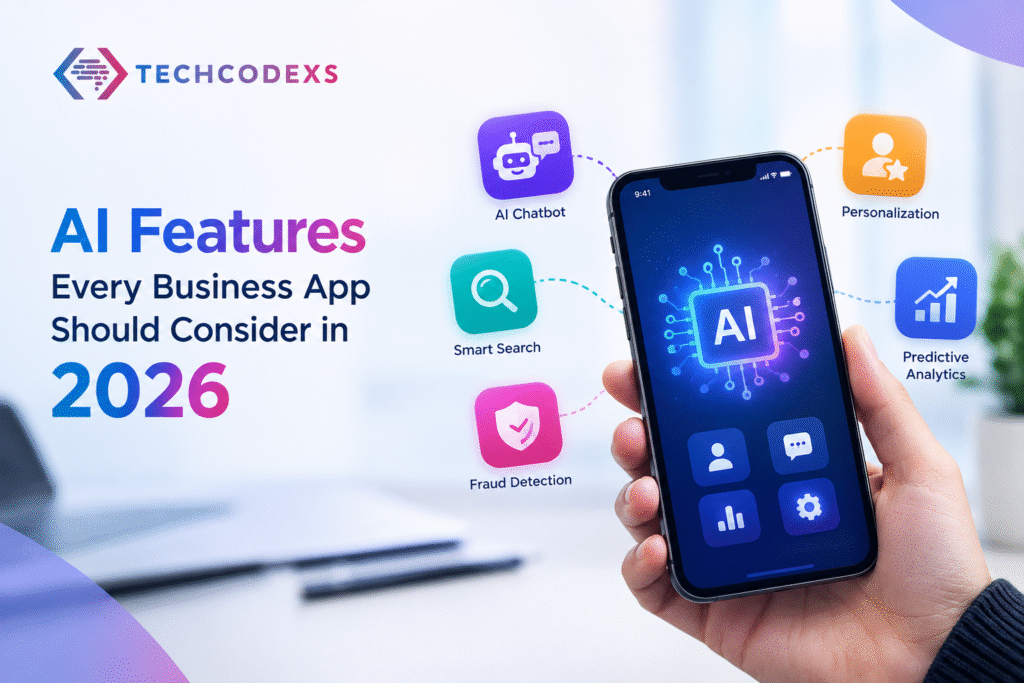
From smarter search to AI-powered customer support, modern App Development is moving toward experiences that can understand user needs and respond more intelligently.
However, adding AI simply because it is trending is rarely a good strategy. Businesses should first identify where AI can solve a real problem, improve the user experience, or reduce repetitive work.
Here are some practical AI features businesses should consider when planning a new app or upgrading an existing one.
1. AI-Powered Personalization
Different users often have different preferences, even when they use the same application.
AI can analyze user interactions, preferences, and previous activity to provide more relevant experiences. For example, an ecommerce app could recommend products based on browsing and purchasing behavior.
Personalization can also be useful in:
- Content recommendations
- Product suggestions
- Personalized offers
- News and media feeds
- Learning applications
- Fitness and lifestyle apps
The objective should be to make the app more useful without making the experience feel intrusive.
2. Intelligent Search
Traditional search usually depends on exact keywords. AI-powered search can understand what users are actually looking for.
For example, instead of searching for a specific product name, a customer could type:
“Show me comfortable shoes for everyday office use.”
An intelligent search system can interpret the intent behind the query and provide more relevant results.
For businesses investing in mobile app development, smarter search can be particularly useful for ecommerce platforms, marketplaces, content apps, and large product catalogs.
3. AI Chatbots and Virtual Assistants
Customer support is another area where AI can provide practical value.
An AI assistant can answer common questions, help users find information, explain services, and guide customers through simple processes.
For example, a travel application could help users find booking information, while an ecommerce app could answer questions about delivery, returns, or product availability.
Businesses should still provide an easy way for users to reach a human support representative when an issue requires personal assistance.
4. Voice-Based App Interactions
Voice technology can make certain applications easier to use, particularly when typing is inconvenient.
Depending on the business, users could use voice commands to:
- Search for products
- Create reminders
- Ask questions
- Navigate an application
- Dictate notes
- Check account information
Voice functionality should be designed around genuine user needs rather than added as a feature simply for novelty.
5. AI-Powered Recommendations
Recommendation systems can help businesses connect users with relevant products, services, or content.
For example:
- A shopping app can recommend related products.
- A streaming platform can suggest content.
- An education app can recommend lessons.
- A travel app can suggest destinations.
- A financial app can organize relevant information.
The recommendation logic should be transparent enough to create useful experiences while respecting user privacy.
6. Predictive Analytics
AI can also help businesses understand what may happen next based on available data.
Predictive features can be used for:
- Demand forecasting
- Customer behavior analysis
- Inventory planning
- Churn detection
- Sales forecasting
- Maintenance alerts
For example, an ecommerce business could analyze historical purchasing patterns to anticipate demand for certain products.
This can turn an app from a simple transaction platform into a useful business intelligence tool.
7. AI-Based Fraud Detection
Security is becoming increasingly important as more business activities move to mobile platforms.
AI can identify unusual patterns that may indicate suspicious activity. Depending on the application, this could include unusual login behavior, abnormal transactions, or unexpected account activity.
Financial services, ecommerce platforms, marketplaces, and subscription-based businesses can particularly benefit from intelligent fraud-monitoring systems.
AI should complement established security practices rather than replace authentication, encryption, access controls, and other security measures.
8. Image and Document Recognition
AI-powered image recognition can reduce manual work inside business applications.
For example, an app could allow users to upload a document and automatically extract relevant information. A retail application could identify products from images, while an insurance app could assist with processing submitted photographs.
This type of functionality can be useful for:
- Document processing
- Receipt scanning
- Product identification
- Identity verification
- Visual search
- Inventory management
The exact implementation depends on the type of data the application handles and the level of accuracy required.
9. AI-Assisted Content Creation
Some business apps can use AI to help users create or organize content.
Potential applications include:
- Generating product descriptions
- Summarizing documents
- Drafting customer responses
- Creating notes
- Rewriting text
- Producing content suggestions
AI-generated content should be reviewed where accuracy is important, especially when applications deal with financial, legal, medical, or other sensitive information.
10. Smarter Notifications
Too many notifications can quickly frustrate users.
AI can help businesses determine which notifications are more relevant to individual users and when they are most useful.
For example, instead of sending every promotional message to every customer, an app could use behavioral signals to deliver more relevant updates.
The goal should be better notifications, not more notifications.
11. AI for Accessibility
AI can also make digital products easier to use for people with different accessibility needs.
Depending on the application, businesses can explore features such as:
- Voice interaction
- Automatic captions
- Text-to-speech
- Speech-to-text
- Image descriptions
- Language assistance
Accessibility should be considered during the design and development process rather than treated as a final-stage addition.
The Web Content Accessibility Guidelines (WCAG) provide internationally recognized guidance for making digital content more accessible.
12. Multilingual AI Experiences
Businesses operating across different markets can use AI-powered language features to make apps more accessible to international users.
Possible applications include:
- Real-time translation
- Multilingual customer support
- Localized content
- Voice translation
- Language-aware search
For a business targeting customers in different countries, multilingual functionality can make the app easier to use without requiring completely separate experiences for every market.
Choosing the Right AI Features for Your App
Not every business app needs every AI feature.
Before adding artificial intelligence, businesses should consider:
Understand the User Problem
Start with the problem users are experiencing. If AI does not make the process easier or more useful, there may be little reason to add it.
Consider Data Requirements
Many AI features depend on quality data. Businesses should understand what information is needed, how it will be collected, and how it will be protected.
Think About Privacy
Apps handling personal information need appropriate privacy and security measures. Businesses should clearly communicate how user data is used.
For businesses operating in relevant jurisdictions, the UK Information Commissioner’s Office guidance on AI and data protection is a useful reference.
Plan for Scalability
An AI feature that works well with a small user base may require a different architecture when usage increases.
A reliable mobile app development company should consider performance, infrastructure, API usage, security, and future expansion from the beginning.
Why the Right Development Team Matters
Successful AI implementation requires more than simply connecting an AI API to an application.
The development team needs to understand user experience, application architecture, data handling, security, testing, and ongoing maintenance.
Experienced mobile app developers UK businesses work with should also be able to explain:
- Which AI features are actually useful
- What data the feature requires
- How the feature will affect app performance
- How user data will be protected
- What the ongoing AI costs may be
- How the application can scale in the future
For web-based products, businesses may also need web app development alongside their mobile application. A consistent experience across web and mobile can make it easier for customers to access services on different devices.
The Future of AI in App Development
AI is likely to become a normal part of digital products rather than a separate technology that users consciously notice.
The most successful applications will not necessarily be those with the largest number of AI features. Instead, businesses can focus on using AI where it makes an existing experience faster, simpler, more relevant, or more accessible.
From intelligent search and personalized recommendations to automated support and predictive analytics, AI gives businesses several ways to improve modern applications.
The key is to start with the user’s needs and then select the technology that solves the problem.
Final Thoughts
AI is creating new possibilities for App Development in 2026. Businesses can use intelligent technologies to personalize experiences, automate repetitive processes, improve customer support, strengthen security, and make applications easier to use.
However, successful implementation depends on choosing the right features, using data responsibly, and building a scalable technical foundation.
Whether you are launching a new application or improving an existing one, working with an experienced development team can help turn AI opportunities into practical features that support your business goals.
Related Articles
Related Posts

How to Choose the Right App Development Company for Your Business
Building a mobile app is a significant investment. Whether you want to create an app…

Why Businesses Are Investing More in Mobile App Development
QUICK ANSWER Investing in mobile app development services is no longer optional—it’s a strategic move…

How Mobile App Development Can Transform Your Business Growth
Mobile usage has exploded over the past decade. Globally, people spend an average of 4–5…