



In today’s competitive online marketplace, successful marketing is no longer based on guesswork. Every click, search, purchase, and interaction generates valuable information that businesses can use to make smarter decisions. Companies that understand how to collect, analyze, and act on this data consistently outperform those relying on assumptions alone.
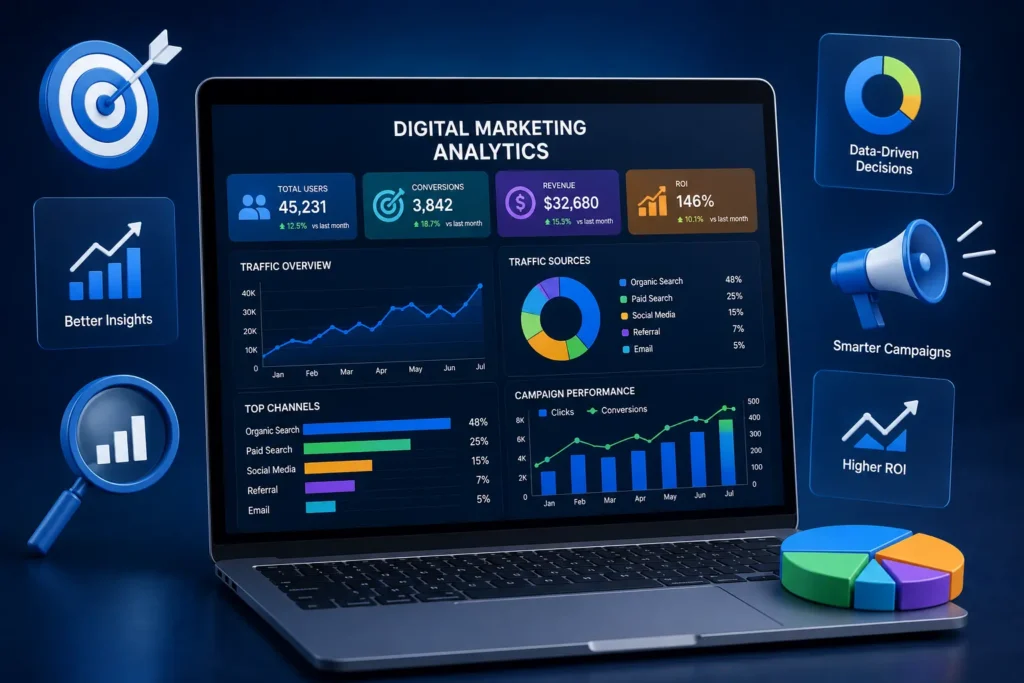
This is where digital marketing analytics plays a crucial role. By transforming raw data into actionable insights, businesses can improve campaign performance, better understand customer behavior, and maximize their return on investment (ROI).
In this guide, you’ll learn what digital marketing analytics is, why it matters, and how it helps businesses make better marketing decisions in 2026 and beyond.
What Is Digital Marketing Analytics?
Digital marketing analytics is the process of collecting, measuring, and analyzing data from digital marketing channels to evaluate performance and improve business outcomes.
It helps businesses answer important questions such as:
- Which marketing channels generate the most leads?
- Which campaigns produce the highest ROI?
- What content attracts the most visitors?
- Where do customers leave the sales funnel?
- Which audience segments are most likely to convert?
Instead of relying on assumptions, marketers use analytics to make informed decisions based on real customer behavior.
Why Digital Marketing Analytics Matters
Every marketing campaign generates data. Without proper analysis, valuable opportunities can be missed.
Using analytics allows businesses to:
- Improve marketing performance
- Reduce wasted advertising spend
- Increase lead generation
- Understand customer behavior
- Personalize customer experiences
- Improve conversion rates
- Measure marketing ROI
Businesses that consistently monitor performance can adapt quickly to changing customer preferences and market trends.
Key Metrics Every Business Should Track
To make informed marketing decisions, businesses should monitor several essential performance indicators.
Website Traffic
Understanding where visitors come from helps identify which marketing channels are delivering results.
Common traffic sources include:
- Organic search
- Paid advertising
- Social media
- Email marketing
- Referral websites
- Direct visits
Tracking these sources helps allocate marketing budgets more effectively
Conversion Rate
Traffic alone doesn’t generate revenue.
Conversion rate measures the percentage of visitors who complete a desired action, such as:
- Filling out a contact form
- Requesting a quote
- Making a purchase
- Downloading a guide
- Booking a consultation
Improving conversion rates often delivers a greater return than simply increasing website traffic.
Customer Acquisition Cost (CAC)
Customer acquisition cost measures how much a business spends to acquire a new customer.
Monitoring this metric helps businesses evaluate the efficiency of their marketing investments.
Reducing acquisition costs while maintaining lead quality improves overall profitability.
Return on Investment (ROI)
One of the most important metrics in digital marketing analytics is ROI.
ROI helps determine whether marketing campaigns generate more revenue than they cost.
By comparing marketing spend with revenue generated, businesses can prioritize the strategies that deliver the greatest value.
How Analytics Improves Marketing Decisions
Analytics provides insights that support better decision-making across every stage of the customer journey.
Better Audience Targeting
Understanding customer demographics, interests, and behaviors allows businesses to create highly targeted campaigns.
Rather than marketing to everyone, businesses can focus on audiences most likely to convert.
Benefits include:
- Higher engagement
- Lower advertising costs
- Better lead quality
- Increased conversions
Smarter Content Strategy
Analytics reveals which content performs best.
Businesses can identify:
- Most-read blog articles
- Highest-converting landing pages
- Popular videos
- Frequently searched topics
- Customer pain points
These insights help marketers create content that aligns with audience interests and search intent.
Improved Advertising Performance
Paid advertising platforms provide detailed campaign analytics.
Businesses can measure:
- Click-through rates
- Cost per click
- Conversion rates
- Audience engagement
- Ad performance
A professional digital marketing and advertising company uses these insights to refine campaigns, reduce wasted spend, and maximize results.
Better Website Optimization
Analytics identifies areas where visitors encounter problems.
Examples include:
- Slow-loading pages
- High bounce rates
- Abandoned checkout pages
- Poor-performing landing pages
Making improvements based on user behavior enhances customer experience and increases conversions.
The Role of a Digital Marketing Agency
Managing analytics requires expertise, strategy, and continuous optimization.
A professional digital marketing agency helps businesses:
- Track campaign performance
- Analyze customer behavior
- Build marketing dashboards
- Improve lead generation
- Optimize conversion rates
- Develop data-driven strategies
Rather than simply reporting numbers, experienced agencies turn data into practical business improvements.
Why Businesses Invest in Digital Marketing Services
Modern marketing involves multiple channels working together.
Professional digital marketing services often include:
- Search engine optimization (SEO)
- Pay-per-click advertising (PPC)
- Email marketing
- Social media marketing
- Content marketing
- Conversion rate optimization
- Analytics reporting
Combining these services with ongoing analytics creates a more effective and measurable marketing strategy.
Why Location Expertise Can Matter
Working with a digital marketing agency London can provide additional advantages for businesses targeting competitive local, national, or international markets.
Experienced agencies often understand:
- Regional search trends
- Local customer behavior
- Industry competition
- Market opportunities
- Geo-targeted advertising
This knowledge helps businesses create campaigns that resonate with their target audiences.
Tools Commonly Used for Digital Marketing Analytics
Successful marketers rely on a range of analytics tools to monitor performance.
Popular solutions include:
- Google Analytics 4
- Google Search Console
- Google Ads
- Microsoft Clarity
- Looker Studio
- CRM reporting platforms
- Social media insights
- Email marketing analytics
These tools provide valuable data that supports continuous improvement.
Common Mistakes Businesses Make
Many businesses collect data but fail to use it effectively.
Common mistakes include:
- Tracking too many metrics
- Ignoring conversion data
- Failing to define clear goals
- Not testing marketing campaigns
- Making decisions without sufficient data
- Overlooking customer behavior
Effective analytics focuses on meaningful insights rather than simply collecting numbers.
Best Practices for Data-Driven Marketing
To maximize the value of analytics:
- Set measurable marketing goals.
- Monitor key performance indicators regularly.
- Test different landing pages.
- Optimize campaigns continuously.
- Review customer behavior frequently.
- Adjust budgets based on performance.
- Combine qualitative and quantitative insights.
Small improvements made consistently often produce significant long-term results.
How Analytics Supports Long-Term Business Growth
Businesses that embrace data-driven marketing are better equipped to:
- Identify new opportunities
- Improve customer experiences
- Increase marketing efficiency
- Generate more qualified leads
- Strengthen customer retention
- Maximize return on investment
Analytics transforms marketing from a series of assumptions into a strategic, measurable process.
Final Thoughts
In an increasingly competitive digital landscape, successful marketing depends on making informed decisions backed by reliable data. Digital marketing analytics empowers businesses to understand customer behavior, optimize campaigns, and invest in strategies that generate measurable results.
Whether you’re partnering with a trusted digital marketing agency, working with a full-service digital marketing and advertising company, investing in comprehensive digital marketing services, collaborating with a digital marketing agency London, or seeking support from an experienced digital marketing company, analytics should be at the heart of every marketing decision.
By consistently measuring performance, testing new ideas, and adapting to customer insights, businesses can build stronger campaigns, improve ROI, and achieve sustainable long-term growth.
Frequently Asked Questions (FAQs)
1. What is digital marketing analytics?
Digital marketing analytics is the process of collecting and analyzing data from online marketing channels to measure performance, understand customer behavior, and improve marketing decisions.
2. Why is digital marketing analytics important?
It helps businesses make informed decisions, optimize campaigns, improve conversion rates, reduce marketing costs, and maximize return on investment.
3. Which metrics should businesses track?
Important metrics include website traffic, conversion rate, customer acquisition cost (CAC), return on investment (ROI), bounce rate, engagement, and lead generation.
4. What tools are commonly used for digital marketing analytics?
Popular tools include Google Analytics 4, Google Search Console, Looker Studio, Google Ads, Microsoft Clarity, CRM platforms, and social media analytics tools.
5. How can a digital marketing agency help with analytics?
A digital marketing agency tracks campaign performance, interprets customer data, identifies growth opportunities, and continuously optimizes marketing strategies to improve business results.
Read More:
How Content Marketing Supports Digital Marketing Success
The Role of Landing Pages in Paid Marketing Campaigns
Email Marketing vs Social Media Marketing: Which Is Better for ROI?
Related Posts
How a B2B Digital Marketing Agency Helps Businesses Generate High-Quality Leads
Generating leads is important for every business, but B2B companies often face a more complicated…
Why Hiring a Digital Marketing Agency Is Better Than Building an In-House Team
Digital marketing has become an important part of how businesses attract customers, build visibility, and…
The Ultimate Digital Marketing Guide for Business Growth in 2026
In 2026, businesses can no longer rely only on traditional advertising to attract and retain…
Email Marketing vs Social Media Marketing: Which Is Better for ROI?
In today’s competitive online landscape, businesses are constantly looking for marketing channels that generate the…